

AISEN - AI for Teachers of Children with SEN
Empowering Teachers working in SEN with the best AI Tools & how best to apply them.
Have you ever dreamed of having your very own teaching assistant by your side at all times? Well, you most certainly can return to school with this dream realised. AI has truly arrived. AI has truly arrived. Now it's time to take it to the next level.

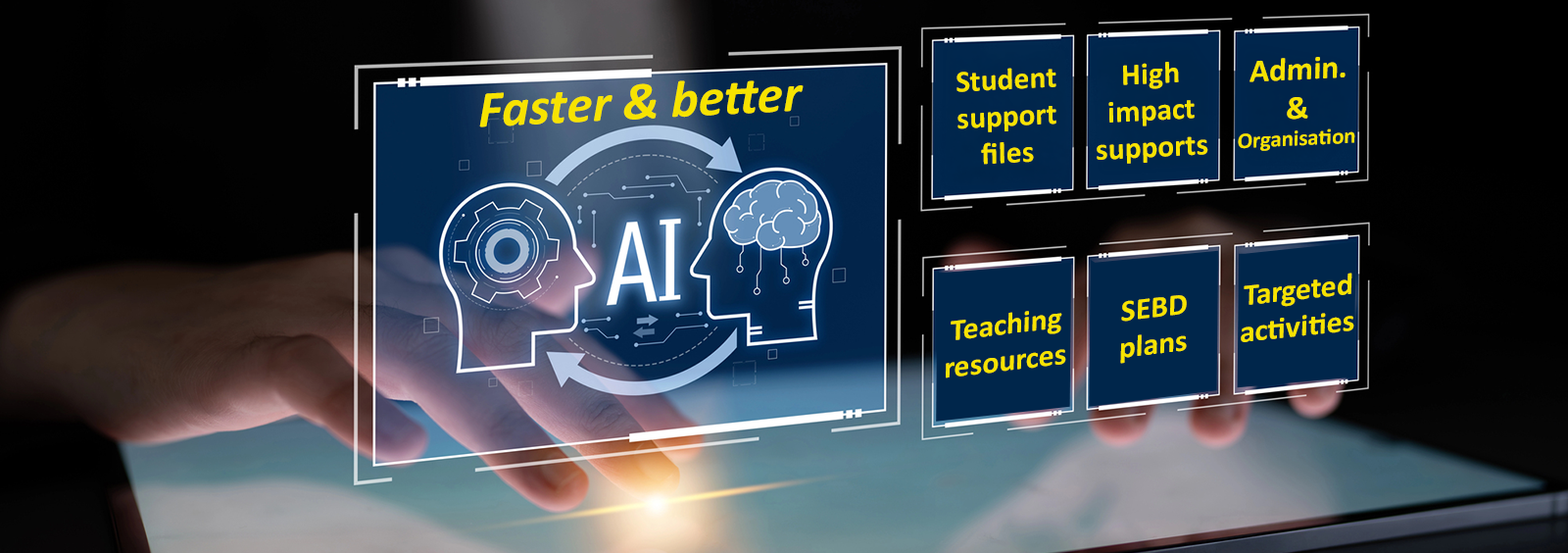
When you combine your Actual Intelligence with Artificial Intelligence, you get a whole new YOU! You can now do everything you need to do as a teacher, but you can do it better, and you can do it so much faster, simply by tapping AI.
SET Teachers, imagine walking into your support classroom setting with absolute confidence, knowing you have the tools, skills, and resources to transform every student’s learning experience, no matter their needs?
Our groundbreaking online AI course is designed specifically for primary school teachers working in Special Educational Needs (SEN). This isn’t just another tech course. It’s a complete, practical, step-by-step guide to mastering AI in a way that genuinely enhances the teaching, learning, and assessment experience for all.
Here is a brief introduction from your course presenter, Mark Delanhunty. Mark is a practising primary school teacher and is recognised as one of the foremost experts on the most effective use of AI to support teaching and learning in the primary school sector.
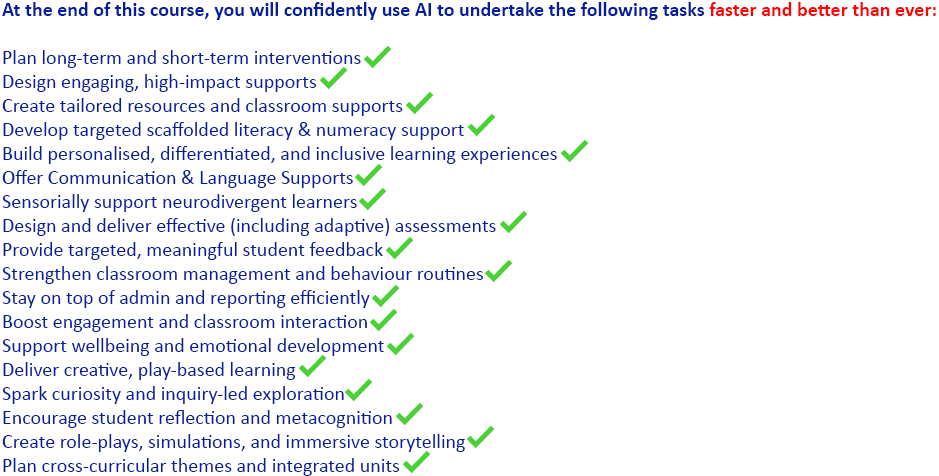
You’ll discover how to use powerful AI tools to create personalised learning materials in minutes, adapt lessons instantly for diverse needs, and unlock new ways to engage even your most reluctant learners, whatever their age and stage. From simplifying planning and reducing workload to generating targeted interventions and meaningful adapted assessments, this course gives you real strategies you can use immediately.
No real prior tech expertise in AI? No problem. Everything is explained clearly, with real classroom examples tailored to SEN settings.
In addition to Mark's expert tuition, you'll hear from several practising Special Education Teachers who share authentic examples of how they use AI to support literacy, numeracy, inclusion, social and emotional development, assessment and planning. Their real-world examples provide practical ideas you can apply immediately in your own setting.
At the end, you won’t just 'understand AI', you’ll use it with confidence, creativity and purpose to enhance the learning experience for all. You’ll stand out as a leader at your school, equipped to deliver inclusive, innovative teaching that truly makes a difference.
This is your opportunity to become a world-class SEN educator in the age of AI.
Are you ready to embrace all AI has to offer and lead the future of learning in SEN settings?
Enrol today in our ‘AI for SEN’ course and be prepared to be transformed in how you will teach.
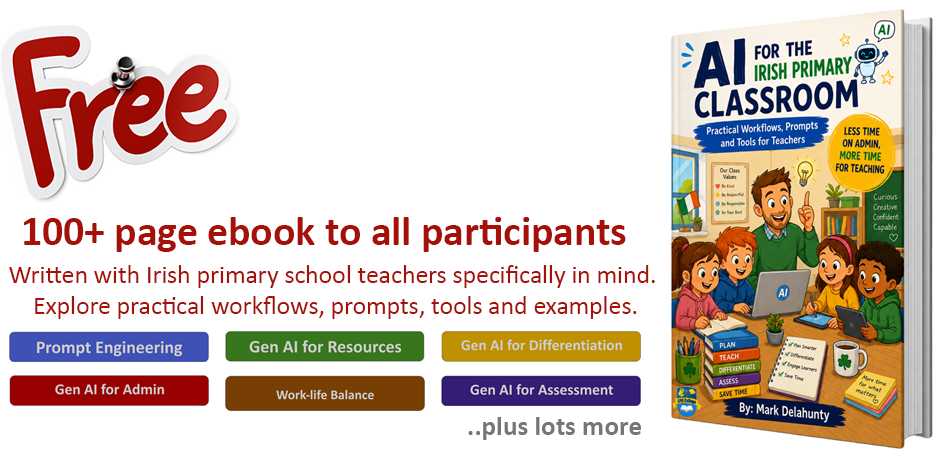
Not only that, but CPD College has commissioned Mark Delahunty, practising primary teacher, author and highly regarded expert on AI in education, to bring you his wisdom, insights and best practices. Mark's ebook ‘AI for the Irish Primary Classroom’ will be available FREE to all participants. This wonderful book has undergone a complete update for 2026.
As Mark says: ‘Now is the time to embark on this transformative path, where technology becomes an invaluable ally in the pursuit of empowering our students and creating enriching educational experiences, a roadmap to reclaiming time, enhancing learning outcomes, and embracing the future of education’.
AND FREE Pro/plus access to top AI platforms for teachers (worth €65).
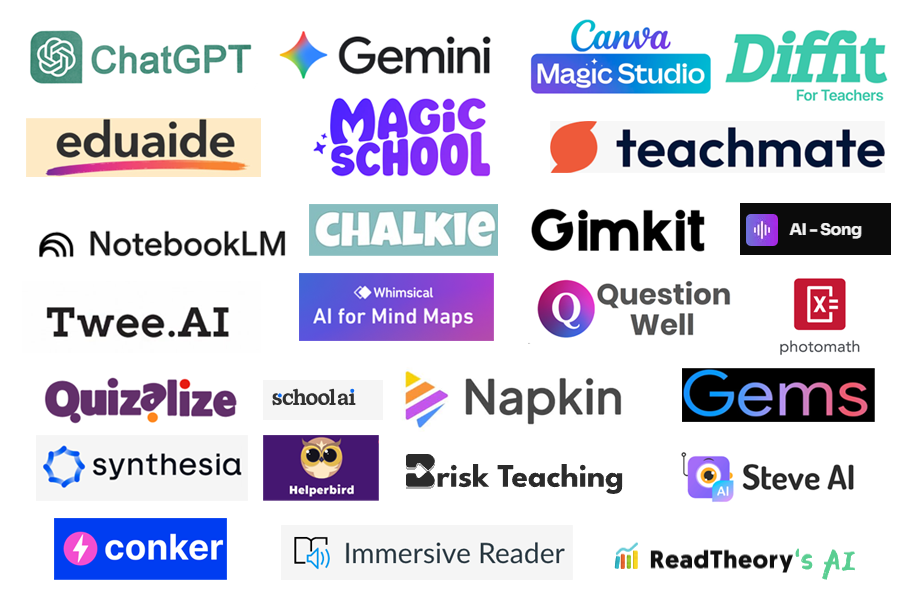
We have reached an agreement with Eduaide (3 months), MagicSchool (3 months) and Teachmate (2 months) to provide our AI course participants with FREE pro/plus access to their platforms. They will also provide some training events on their platform to our participants. These platforms are incredible, offering a huge range of dedicated AI tools for teachers. Why not engage fully with each one and see what they have to offer?
Here is just a selection of the many AI tools that we demonstrate in this course.
Let us embark on this remarkable, exciting journey together to discover the best AI tools for the classroom and reclaim your work-life balance!
NOTE:
The online format of this course enables you to study at a time and place that best suits your own needs.
You can access your course from July 1st to August 21st 2026.
Within this highly interactive web-based course, a dynamic learning experience awaits. You can interact with your fellow course participants through the in-course chat forums and communication tools provided by the CPD College learning system.
Our friendly and knowledgeable tutors actively support each course, providing expert interaction, guidance and feedback for all participants on chat questions and assignments that call for critical reflection, self-analysis and a reasoned response.
On successful completion of your course, you can download and print off your CPD record and certificate of completion.
We look forward to welcoming you to your course.
- Strengthen teachers understanding of the SEN problem-solving process (identify need, plan, implement, review) and to demonstrate how AI can enhance planning, documentation, differentiation and review while maintaining teacher-in-the-loop professional judgement.
- Improve literacy outcomes for pupils with SEN by developing teachers competence in using AI to analyse information, draft measurable targets aligned with the Primary Language Curriculum, create differentiated resources and critically evaluate AI-generated materials for developmental appropriateness and evidence-informed practice.
- Improve numeracy outcomes for pupils with SEN by enabling teachers to use AI to support PMC-aligned planning, generate visual models and worked examples, draft numeracy targets and assist with monitoring and reviewing progress, while ensuring mathematical accuracy and conceptual integrity.
- Support inclusive classroom practice through Universal Design for Learning (UDL) by demonstrating how AI can assist in creating multimodal supports, accessible resources and differentiated materials that reduce barriers to participation and engagement.
- Develop teachers capacity to use AI to support pupils with social, emotional and behavioural needs (SEBD), including the creation of social narratives, behaviour reflection tools, self-regulation supports, visual schedules and restorative prompts, while promoting dignity, strengths-based language and pupil wellbeing.
- Strengthen teachers ability to use AI to support monitoring, review and School Self-Evaluation (SSE) processes, including synthesising information, drafting professional review language and identifying evidence-informed next steps within the Continuum of Support.
- Embed ethical, responsible and legally compliant AI practice in SEN contexts, including critical evaluation of AI outputs, awareness of bias and limitations, data protection considerations and clear professional accountability.
- Reduce the administrative burden associated with SEN documentation and planning, enabling teachers to devote more time to high-quality teaching, intervention and meaningful engagement with pupils.
- Foster reflective, evidence-informed professional practice, empowering teachers to integrate AI purposefully and sustainably into SEN provision in ways that enhance inclusion, improve pupil outcomes and support ongoing professional learning.
|
01 - AI in the SEN context This module establishes the SEN framework underpinning inclusive education in Irish primary schools and explicitly develops teachers' AI capability within it. Participants engage with national SEN guidance, the Continuum of Support and the problem-solving process and examine how these structures guide professional decision-making. A central focus of the module is how AI can practically support teachers to work more effectively within established SEN systems. Participants explore how AI tools can be used to engage with and summarise policy documents, extract key requirements and organise SEN-related information in a clear and accessible manner. Examples include using AI to generate plain-language summaries of guidance for staff or parents, draft role checklists for SET teachers and create visual overviews of the Continuum of Support. The module explicitly teaches the limitations of AI in SEN contexts. Participants examine why AI cannot replace professional judgement, diagnostic processes or collaborative decision-making. Ethical considerations are foregrounded, including the importance of teacher-in-the-loop oversight, critical evaluation of outputs, awareness of bias and compliance with data protection and confidentiality requirements. At the end of the module, participants will understand not only what AI can do, but how and when it should be used to support SEN practice responsibly and effectively. |
|
02 - AI to support Literacy needs This module explicitly develops teachers' AI capability for literacy support in SEN contexts, while remaining grounded in the Primary Language Curriculum and the SEN problem-solving process. Participants explore how literacy needs are identified using multiple information sources and how priorities are established across the Continuum of Support. A central focus is on how AI can support teachers to work more effectively and efficiently in literacy planning and differentiation. Participants examine practical uses of AI such as organising assessment notes, drafting PLC-aligned literacy targets, generating differentiated texts, creating writing scaffolds, adapting language level and producing visual supports to aid comprehension. The module addresses key components of literacy development, including oral language, phonological awareness, decoding and word recognition, fluency, vocabulary, comprehension, spelling and writing. For each area, participants consider how AI outputs must be critically evaluated and adapted to ensure they reflect evidence-informed practice and the specific needs of the pupil. Strong emphasis is placed on the limitations of AI in literacy teaching. Participants explore why AI cannot replace teacher expertise, assessment judgement or responsive teaching and how inappropriate or uncritical use could undermine effective intervention. Teacher-in-the-loop oversight, bias awareness and professional responsibility are consistently reinforced. |
|
03 - AI to support numeracy This module explicitly develops teachers' AI capability for numeracy planning, monitoring and review in SEN contexts, while remaining firmly grounded in the Primary Mathematics Curriculum and evidence-informed practice. Participants explore how numeracy needs are identified and prioritised using multiple sources of information and how supports are planned and adjusted across the Continuum of Support. A central focus of the module is how AI can support teachers in enhancing clarity, representation and responsiveness in numeracy teaching. Participants examine practical uses of AI such as generating visual models (e.g. number lines, arrays, bar models), drafting step-by-step worked examples, supporting maths language development and creating differentiated practice tasks aligned to specific learning intentions. The module addresses common barriers to progress in numeracy for pupils with SEN, including difficulties with number sense, conceptual understanding, working memory demands, maths language and anxiety. Participants consider how structured approaches such as concrete–pictorial–abstract (CPA), explicit instruction and purposeful practice can be supported, but not replaced by AI-generated resources. Monitoring and review are explicitly taught. Participants explore how AI can assist with summarising evidence of pupil response to intervention, drafting review notes and identifying next steps, while emphasising that decisions about effectiveness and progression remain the responsibility of the teacher. The limitations of AI, particularly regarding mathematical accuracy and nuance, are critically examined. |
|
04 - AI to support wellbeing & inclusive pedagogies This module explicitly develops teachers' AI capability for inclusive practice, including support for pupils with social, emotional and behavioural needs (SEBD), through the lens of Universal Design for Learning and pupil wellbeing. Participants explore how UDL principles (multiple means of engagement, representation and expression) support inclusive teaching for pupils with SEN and reduce the need for reactive or individualised adjustments. A central focus is on how AI can be used to support inclusive design at the planning stage. Participants examine practical applications such as generating simplified language versions of instructions, creating visual schedules and task breakdowns, producing alternative representations of content, drafting social narratives, developing behaviour reflection templates and creating self-regulation prompt cards and choice boards. These AI-supported tools are considered in the context of promoting independence, emotional regulation, positive behaviour and meaningful participation. The module also explores how structured supports, predictable routines and clear communication contribute to pupil wellbeing and engagement. Participants examine how AI can assist in drafting restorative conversation prompts, emotional check-in tools and behaviour support visuals, while reinforcing that sensitivity, context and professional judgement are essential. Limitations and ethical considerations are addressed throughout. Participants examine potential risks such as over-simplification, stereotyping, inappropriate labelling or deficit language and learn how to critically review and adapt AI-generated materials to ensure they are respectful, strengths-based and aligned with professional standards. |
|
05 - Embedding effective AI into practice This module consolidates learning across the course by explicitly developing teachers' AI capability for review, reflection and SSE-informed improvement. Participants explore how evidence from monitoring and review is used to evaluate the impact of SEN supports on pupil learning, participation and wellbeing, with particular emphasis on literacy and numeracy outcomes. The module revisits the problem-solving process and examines how review information feeds back into planning and decision-making across the Continuum of Support. Participants explore SSE principles and relevant indicators, focusing on learner outcomes, learner experiences and teacher practice and how these inform priority actions for improvement. A central focus is on how AI can support teachers in managing and synthesising complex information. Practical applications include using AI to organise monitoring notes, draft reflective summaries, identify patterns or themes in review data and support the preparation of concise action-focused evaluations. Participants are guided to critically review AI-generated outputs to ensure they remain accurate, contextualised and professionally appropriate. AI Literacy and ethical considerations are reinforced throughout, including the authenticity of reflection, the avoidance of over-reliance on AI-generated language, and the importance of professional ownership of evaluative judgements. |
' Hands down the best course I've ever done for EPV or on AI because it just showed me how to use and link it in ways I'd never have thought of before. Outstanding, thank you'. Clare. 2025